Our Studio
We provide a welcoming studio where our clients are encouraged to become stronger, leaner, healthier and happier.

Pilates Apparatus
The Pilates method focuses on the core postural muscles, spinal alignment and awareness of the breath. The exercises develop stability and poise through controlled motions, utilising oppositional forces to lengthen and strengthen the body. Joseph Pilates' ingenious use of springs, pulleys and straps provides gentle resistance, ensures greater precision and more control in the execution of the movements.
Our studio is equipped with a suite of Reformers, Towers and Wundachairs for classes, Cadillacs, a High Chair, Ladder Barrel, and other smaller pieces of equipment that teachers can use to provide just the right exercise for your body.

Reformer
The Universal Reformer was one of the first full pieces of apparatus designed and used by Joseph Pilates. He patented it in 1927 as a "Gymnastic Apparatus", later changing the name to the Universal Reformer in 1929. He termed it this as it was designed to correct poor posture, restore natural spinal alignment and reform an individuals movement habits. You can lie, sit or kneel on the Reformer to perform exercises which involve controlled movements against gentle resistance provided by springs. The moving carriage provides a supportive platform for the body but the level of difficultly can be varied through adjusting the spring tension and use of straps.

Cadillac
The Pilates Cadillac is reported to have been named after its automobile counterpart. This large and supportive piece of apparatus is ideal for rehabilitation work, but the Cadillac repertoire also stretches and strengthens bodies of all ages and ability. This hugely versatile piece of equipment can be used for simple spring-assisted sit ups through to more complex motions, like advanced acrobatics.

Tower
The Tower has lots of the same springs and functionality as the Cadillac but it’s concentrated into one wall unit. It can be combined with the reformer or raised mats, allowing for an enormous variety of exercises that challenge the body's stability and build strength and flexibility harmoniously.

Accessories
Every piece of apparatus can be extended with a host of accessories. For example, the ‘jumping board’ pictured can be added to the reformer to enable jumping exercises. The Airplane board in the image above is an example of an accessory on the Cadillac which improves stability.

Wunda Chair
The Wunda Chair will put your stamina and balance to the test. You can sit, kneel or stand on the Wunda chair, and operate the ‘pedal’ with your arms or legs. As with all the apparatus, the level of difficulty can be adjusted by altering the springs. It is usually used for intermediate clients but we have found such value in getting beginners to learn certain techniques. It’s one of the small pieces but it certainly packs a punch!
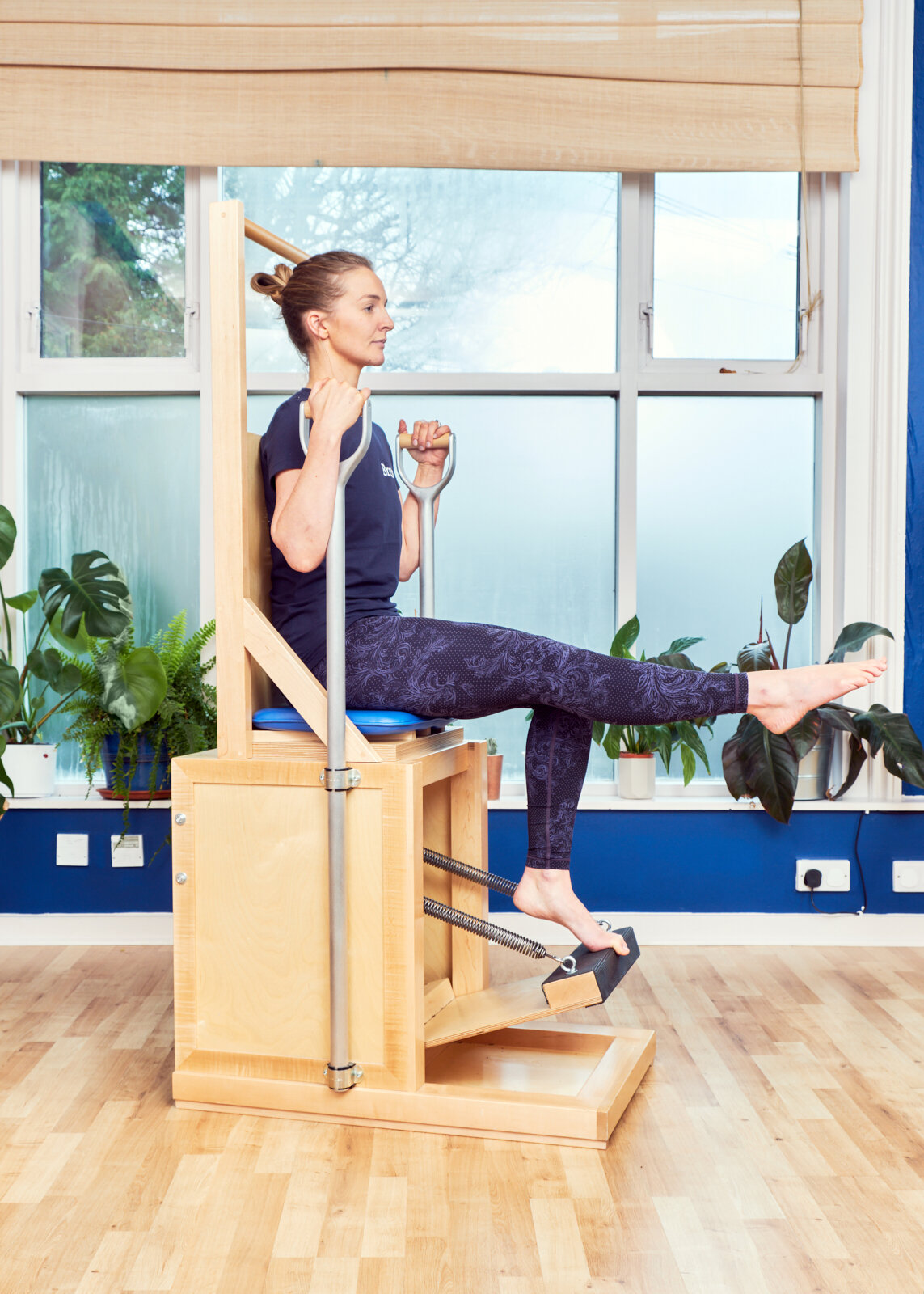
High Chair
Similar to the Wunda Chair but with supportive handles and heavier springs. The High Chair can accommodate a variety of exercises at all levels. It helps with alignment, finding the centre and strengthening. Many exercises on the High Chair serve both the strengthening of legs, hips and glutes, as well as the targeting muscular imbalances. It one of our faves as it can get into the lower body so well.

Ladder Barrel
The Ladder Barrel provides you with a variety of ways to increase your flexibility, lengthen your spine, and enhance your overall posture. While working on alignment, the barrel excels in allowing individuals to reach their maximum range of motion without resistance or external pressure. It helps anchor the lower body, so the torso is free to reach its maximum range of motion, challenging core stability and strength.

Small Barrel
Despite having the same curvature as the Spine Corrector, the Small Barrel's shallow height accommodates movers who have less flexibility. A great start to extending the range of motion but also a great challenge to incorporate into a full workout.

Spine Corrector
The Pilates Spine Corrector (also called a step barrel) is the middle child of the three barrels in the studio. The Spine Corrector is designed to strengthen muscles, lengthen the spine and provides the user with support to open the chest and restore the spine to its natural curves.

Ped O Pul or Pedipole
The Ped O Pul is the most advanced piece of apparatus in the studio. Its a tall, slightly flexible, vertical pole with attached springs and handles, which challenges balance and posture due to its minimal support.

Breath-a-ciser
A Classical breathing apparatus designed to strengthen all the respiratory muscles, from the diaphragm to the intercostal muscles. It helps improve respiratory stamina and deepen the connection to the powerhouse.

Foot Corrector
This device strengthens the arches of the feet and improves weight distribution. The Foot Corrector also tones and strengthens the lower body while connecting the feet and legs to your centre.

Neck Stretcher
Designed by Joseph Pilates for his boxers, the Neck Stretcher is designed to elongate and strengthen neck muscles and re-align head posture.
A bit of history…
Joseph Pilates was a pioneer in exercise theory long before familiar terms like sports science and movement analysis were coined. Born in 1883, he suffered from asthma, rickets and rheumatic fever as a child but overcame these ailments through a range of exercise regimes. He devoted his life to studying and collating the exercise regimes, which he tested and explored himself and through working with patients during his internment in the UK during World War I.
The exercise method that Pilates developed was originally called 'Contrology'. It involved a series of mat-based exercises that "develops the body uniformly, corrects wrong postures, restores physical vitality, invigorates the mind & elevates the spirit." At the core of the Contrology method is a focus on the core postural muscles, spinal alignment and awareness of the breath. The exercises develop stability and poise through controlled motions, utilising oppositional forces to lengthen and strengthen the body. His book, 'Return to Life through Contrology', made these exercises available to the general public in 1945 and they have since gone on to form the core of the mat exercises that are taught in Classical Pilates classes around the world.